Glow Peptides for Skin Vitality & Dermal Research
Explore Glow Peptides formulated for laboratory research involving dermal signaling, extracellular matrix biology, cellular repair pathways, oxidative processes, and peptide interactions associated with skin and connective-tissue research.
At Peptide Sciences, our Glow Peptide category focuses on specialized multi-peptide formulations designed to give researchers access to complementary peptide sequences within a single research blend.
All Glow Peptides available through this category are supplied strictly for scientific, analytical, identification, and laboratory research purposes.
What Are Glow Peptides?
The term Glow Peptides describes research formulations containing peptides commonly investigated in experimental models involving dermal biology, extracellular matrix signaling, tissue-related cellular pathways, and peptide-mediated communication.
Rather than focusing on a single molecular pathway, a Glow peptide blend allows researchers to investigate how several peptide compounds behave within the same controlled experimental model.
This makes Glow formulations particularly relevant to research involving cellular signaling, connective-tissue biology, collagen-associated pathways, vascular signaling, oxidative mechanisms, and dermal extracellular matrix research.
BPC-157, TB-500 & GHK-Cu Glow Blend
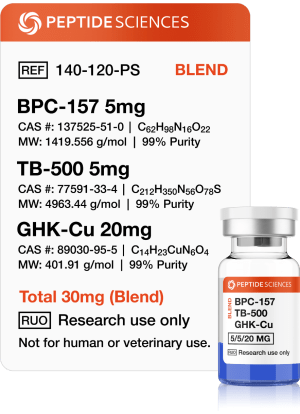
The primary product within our Glow Peptides collection is the BPC-157, TB-500 & GHK-Cu 30mg Glow Blend.
This research formulation combines three distinct peptides that are associated with different areas of biochemical investigation:
- BPC-157 – investigated in laboratory models involving cellular signaling, vascular pathways, connective tissue, and tissue-associated biological processes.
- TB-500 – a research peptide associated with studies of actin regulation, cell migration, cytoskeletal organization, and tissue-related signaling.
- GHK-Cu – a copper-binding tripeptide widely investigated in dermal research, extracellular matrix biology, fibroblast signaling, collagen-associated pathways, and copper-mediated cellular processes.
Combining these compounds creates a useful multi-peptide research model for laboratories interested in studying several complementary signaling mechanisms within a single formulation.
GHK-Cu & Dermal Research
GHK-Cu is particularly relevant to the scientific identity of the Glow Peptide category. This naturally occurring copper-binding tripeptide is widely studied in experimental models involving extracellular matrix signaling, fibroblast biology, structural proteins, cellular communication, and copper-dependent biochemical processes.
Researchers studying GHK-Cu independently can also compare Glow formulations with other copper-peptide research compounds available throughout the broader Peptide Sciences catalog.
BPC-157 & TB-500 Research
BPC-157 and TB-500 add different research pathways to the Glow formulation. While their molecular structures and experimental targets differ, both compounds are commonly investigated in research relating to cellular migration, tissue-associated signaling, extracellular environments, and molecular responses to experimental stress.
The combination therefore allows researchers to compare interactions between copper-peptide research and other peptide signaling mechanisms within controlled laboratory models.
Glow Peptide Research Applications
Depending on the experimental design, Glow Peptides may be investigated in laboratory models involving:
- Dermal cellular signaling
- Extracellular matrix biology
- Collagen-associated pathways
- Fibroblast research
- Copper-peptide interactions
- Cell migration mechanisms
- Cytoskeletal signaling
- Connective-tissue research
- Oxidative-stress pathways
- Vascular and endothelial signaling
- Multi-peptide interaction studies
These areas represent research applications rather than claims of therapeutic, cosmetic, or medical effects.
Glow Peptides vs Individual Research Peptides
Individual peptides allow researchers to isolate and examine a specific compound, while a Glow peptide blend provides a different experimental approach by combining multiple research sequences.
Researchers designing controlled comparative studies may therefore choose to investigate the individual peptides separately before evaluating a combined formulation.
The best format depends on the hypothesis, experimental model, concentration requirements, controls, and analytical methods being used.
Why Choose Peptide Sciences for Glow Peptides?
Peptide Sciences organizes specialized peptide formulations according to their research applications, making it easier for laboratories to identify relevant compounds and compare individual peptides with multi-peptide blends.
Before incorporating a Glow formulation into a research protocol, researchers should review product concentration, formulation details, available analytical documentation, storage information, and relevant scientific literature.
Browse all Peptide Sciences research peptides to explore individual compounds, peptide blends, topical formulations, capsules, and additional research products.
Research Use Only: Glow Peptides and all compounds listed in this category are intended strictly for laboratory, analytical, identification, and scientific research purposes. They are not intended for human or animal consumption, cosmetic application, medical use, diagnosis, treatment, prevention of disease, or therapeutic use.