
Uncategorized
lyophilized peptides
Aug
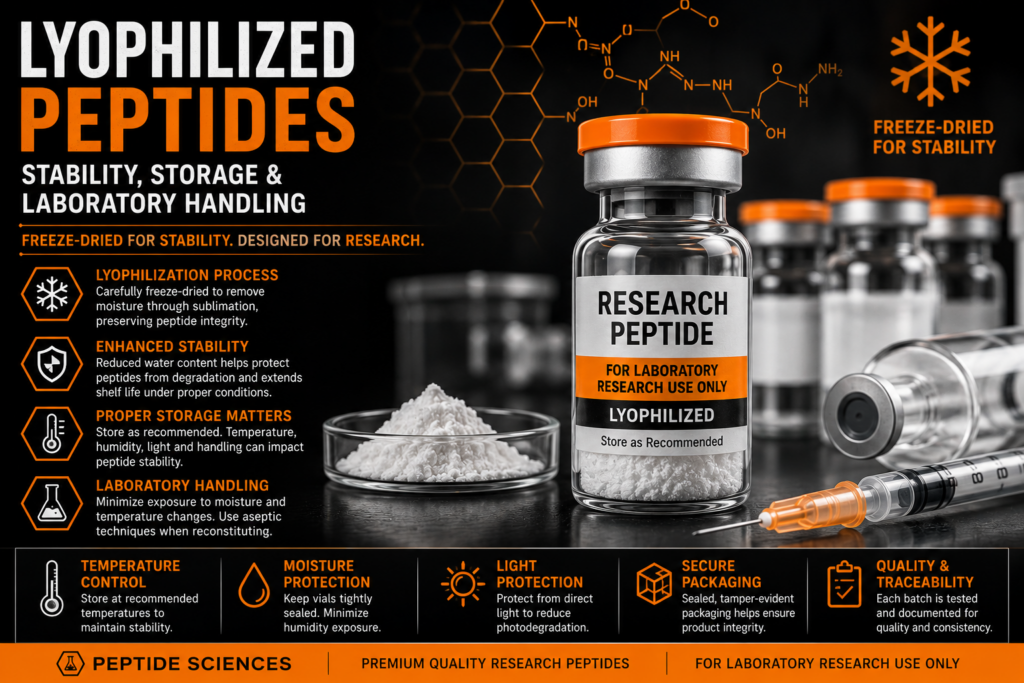
Lyophilized Peptides: Stability, Storage & Laboratory Handling
Lyophilized peptides are peptide materials that have undergone freeze-drying to remove much of the water from the formulation. This approach is widely used with sensitive laboratory and pharmaceutical materials because reducing water content can help improve physical and chemical stability during storage.
However, lyophilization does not make every peptide indefinitely stable. Molecular sequence, formulation, residual moisture, temperature, light exposure, packaging, oxygen, and handling conditions can all influence how a peptide changes over time.
This guide from Peptide Sciences explains how lyophilization works, why peptides are often supplied as freeze-dried materials, which environmental factors can influence stability, and what researchers should consider when handling peptide materials in the laboratory.
What Is a Lyophilized Peptide?
A lyophilized peptide is a peptide-containing material that has been processed through freeze-drying.
During lyophilization, a material is first frozen. Pressure is then reduced so frozen water can be removed primarily through sublimation, meaning ice transitions directly from the solid phase to vapor rather than first becoming liquid.
The process generally involves freezing, primary drying, and secondary drying. The objective is to remove water while maintaining characteristics of a material that could be negatively affected by conventional drying conditions.
For general biochemical background on amino-acid chains, researchers can also review the definition of a peptide.
Why Are Research Peptides Often Lyophilized?
Peptides can be sensitive to environmental conditions, particularly when dissolved in solution.
Water can provide an environment in which several chemical degradation pathways become more likely. Depending on the molecular sequence and formulation, peptide materials may undergo processes such as hydrolysis, oxidation, aggregation, deamidation, or other chemical changes.
Removing much of the water can reduce molecular mobility and help create conditions that are more favorable for storage.
Lyophilization is therefore commonly used when manufacturers or laboratories need to convert a peptide-containing solution into a dry material suitable for controlled storage and later analytical use.
How Does Lyophilization Work?
Although industrial freeze-drying processes can be technically complex, the basic process can be understood in three main stages.
1. Freezing
The starting material is cooled until water within the formulation freezes.
The freezing stage can influence ice-crystal formation, product structure, drying behavior, and the characteristics of the final lyophilized material.
2. Primary Drying
During primary drying, pressure is reduced and controlled energy is supplied so frozen water can leave the material through sublimation.
A substantial portion of the water is removed during this stage.
3. Secondary Drying
After most frozen water has been removed, additional drying can reduce remaining water associated more closely with the material.
The amount of residual moisture left after processing can be an important characteristic of a lyophilized formulation.
Does Lyophilization Make Peptides Completely Stable?
No.
Lyophilization can improve stability for many materials, but it does not stop every possible degradation pathway.
Even in the solid state, molecular reactions can occur. The rate and type of change depend on the peptide sequence, formulation, residual moisture, storage temperature, packaging, and environmental exposure.
This is why researchers should avoid assuming that every lyophilized product has the same shelf life or the same ideal storage conditions.
Why Peptide Sequence Matters for Stability
Two peptides stored under identical conditions may not behave identically.
The amino-acid sequence itself can influence susceptibility to different degradation pathways.
Certain residues or structural features may make particular peptides more vulnerable to oxidation, hydrolysis, deamidation, disulfide-related changes, aggregation, or other reactions.
Researchers should therefore evaluate stability at the level of the individual compound rather than applying one universal rule to every peptide in a catalog.
Temperature and Lyophilized Peptide Stability
Temperature is one of the most important environmental variables considered during stability studies.
Higher temperatures generally increase molecular motion and can accelerate many chemical reactions. Lower controlled temperatures are therefore frequently evaluated for peptide and biological materials.
However, the correct storage condition for a particular research compound should come from product-specific stability information rather than an assumption that one temperature is suitable for every peptide.
Regulatory stability programs evaluate materials under defined temperature conditions to determine how quality changes over time.
Why Moisture Matters
Lyophilization removes water, but a freeze-dried material is not necessarily completely free of moisture.
The amount of water remaining after freeze-drying is often described as residual moisture.
Residual moisture can influence the physical properties and chemical stability of a lyophilized material.
Too much moisture may increase molecular mobility or support certain degradation pathways. At the same time, the relationship between dryness and stability can depend on the particular formulation, meaning that simply making every product as dry as technically possible is not automatically the optimal approach.
This is one reason moisture levels are evaluated as part of formulation and stability development.
Protecting Lyophilized Materials From Humidity
Even after freeze-drying, environmental humidity may matter if moisture enters the container.
A lyophilized material can absorb moisture from the surrounding environment when packaging or container closure is inadequate or when the material is repeatedly exposed to humid air.
Moisture uptake can change the physical state of a formulation and potentially influence stability.
Researchers should therefore pay attention to container integrity and product-specific handling instructions.
Does Light Affect Peptide Stability?
Some peptide materials and associated formulation components can be sensitive to light.
Photochemical reactions may contribute to degradation in susceptible compounds, which is why light exposure is one of the environmental conditions considered during pharmaceutical stability testing.
The degree of light sensitivity varies by molecular structure and formulation.
Researchers should follow compound-specific information rather than assuming all peptides require identical protection.
Why Packaging Matters
The container surrounding a lyophilized peptide is part of the material’s storage environment.
Packaging can influence exposure to:
- Moisture
- Oxygen
- Light
- Environmental contamination
- Temperature changes during transport
Container-closure integrity can therefore contribute to maintaining the conditions under which a lyophilized material was intended to remain stored.
What Should a Lyophilized Peptide Look Like?
The appearance of freeze-dried material can vary substantially depending on formulation, fill volume, excipients, drying cycle, and manufacturing process.
Some lyophilized products form a visible solid cake, while others may appear as a thinner layer or powder-like material.
Appearance alone should not be used to establish identity or purity.
Analytical techniques and appropriate documentation provide more useful information when confirming the characteristics of a research material.
For more information on analytical evaluation, see Peptide Purity Testing: HPLC, Mass Spectrometry & COAs.
Lyophilized Peptide Stability vs Peptides in Solution
The physical state of a peptide can strongly influence its stability profile.
A peptide dissolved in solution has greater molecular mobility and continuous interaction with the solvent environment.
Depending on the molecule and conditions, solution-phase degradation pathways may occur more readily than in a properly developed dry formulation.
Freeze-drying is therefore frequently used when longer-term stabilization of sensitive peptide or protein materials is desired.
This should not be interpreted to mean every dry peptide is stable indefinitely or every peptide solution is inherently unstable. Stability remains dependent on the individual compound and formulation.
What Happens After a Lyophilized Peptide Is Reconstituted?
Adding an appropriate laboratory solvent changes the material from a dry state into a solution.
Once dissolved, the peptide is exposed to a different chemical environment. Factors such as solvent composition, pH, concentration, temperature, light, oxygen, and time can then influence solution stability.
Because different peptides respond differently to these conditions, researchers should use product-specific laboratory protocols and validated experimental procedures rather than applying universal handling assumptions.
This article does not provide instructions for human or animal administration.
Why Repeated Temperature Changes Can Matter
Repeated movement between different storage environments may expose research materials to thermal and moisture-related changes.
For certain materials, condensation can become relevant when a cold container is exposed to warmer humid air.
Repeated temperature cycling may also influence the physical characteristics of some formulations.
Laboratories should therefore design storage and sampling procedures that minimize unnecessary environmental exposure while remaining consistent with the validated requirements of the specific material.
Freeze-Thaw Cycles and Peptide Solutions
Freeze-thaw behavior is particularly important when peptide materials are already in solution.
Freezing can change local concentrations of solutes, alter pH microenvironments, and affect interactions between molecules.
Some peptides tolerate freeze-thaw exposure better than others.
Researchers performing repeated analytical studies should therefore determine whether freeze-thaw stability has been evaluated for the specific material rather than assuming repeated cycles have no effect.
How Does Oxidation Affect Peptides?
Oxidation is another possible peptide degradation pathway.
Susceptibility depends heavily on molecular sequence and environmental conditions.
Exposure to oxygen, light, trace metals, temperature, and formulation conditions can contribute to oxidative reactions in susceptible molecules.
Analytical methods such as chromatography and mass spectrometry may be used during stability studies to investigate changes associated with degradation products.
What Is Peptide Aggregation?
Aggregation occurs when molecules associate with one another to form larger structures.
Some peptides and proteins are more prone to aggregation than others.
Aggregation behavior can be influenced by concentration, sequence, pH, temperature, ionic environment, interfaces, formulation ingredients, and physical stress.
This is another example of why stability cannot be predicted solely from the word “peptide.”
Why Stability Testing Uses Multiple Time Points
A single analytical result provides information about a material at one point in time.
Stability studies evaluate materials over defined periods under controlled environmental conditions.
Researchers may track characteristics such as:
- Appearance
- Purity
- Molecular identity
- Degradation products
- Moisture
- Physical structure
- Concentration or content
- Other compound-specific attributes
Comparing results over time helps determine whether significant changes occur under particular storage conditions.
Real-Time vs Accelerated Stability Studies
Stability programs may include both real-time and accelerated studies.
Real-Time Stability
Real-time studies evaluate a material under its intended storage conditions over an extended period.
Accelerated Stability
Accelerated studies expose materials to more stressful environmental conditions to investigate how stability-related changes may develop.
Accelerated testing can provide useful scientific information, but it does not automatically replace appropriate real-time stability data.
Why There Is No Universal Peptide Storage Rule
The term “research peptide” covers a large and chemically diverse group of molecules.
For example, the growth hormone peptide category includes GHRH-associated compounds, growth-hormone secretagogues, IGF-related molecules, and combinations.
The metabolic research category includes molecules associated with GLP-1, GIP, glucagon, amylin, and other pathways.
Likewise, nootropic research peptides, tissue-response peptides, and collagen research peptides represent chemically different groups.
It would therefore be scientifically inappropriate to assume every product in these categories has identical stability characteristics.
Laboratory Handling Considerations
When working with lyophilized research materials, good laboratory practice should focus on preserving sample identity and limiting unnecessary environmental exposure.
Researchers may consider:
- Following the product-specific storage information
- Maintaining clear sample and batch identification
- Protecting materials from unnecessary moisture exposure
- Limiting unnecessary temperature cycling
- Using appropriate laboratory containers
- Monitoring storage equipment
- Documenting handling conditions
- Following validated analytical protocols
These principles support traceability and reproducibility without assuming that all peptide materials require exactly the same conditions.
Why Batch Documentation Matters for Storage
Stability information becomes more useful when researchers can connect it to a specific product and batch.
A product name alone may not provide enough information to determine when a material was produced, which analytical documentation applies to it, or which stability data were generated for that batch or formulation.
Researchers reviewing peptide testing and COA information should therefore pay attention to batch traceability as well as analytical results.
Common Misconceptions About Lyophilized Peptides
“Lyophilized Means the Peptide Cannot Degrade”
Incorrect. Freeze-drying can improve stability but does not eliminate every chemical or physical degradation pathway.
“All Peptides Should Be Stored the Same Way”
Incorrect. Stability depends on molecular sequence, formulation, packaging, and compound-specific data.
“A Dry Powder Is Automatically Pure”
Incorrect. Physical appearance does not establish analytical purity or molecular identity.
“A Purity Test Automatically Proves Stability”
Incorrect. Purity testing provides analytical information at a particular time. Stability requires evaluating how relevant characteristics change over time under defined conditions.
“Lyophilization Removes All Water”
Not necessarily. Lyophilized formulations can retain residual moisture, and the amount may influence product behavior.
How Peptide Sciences Organizes Research Materials
Peptide Sciences organizes research compounds according to their primary molecular and experimental context.
Researchers can compare materials across growth-hormone research, metabolic pathways, tissue-response biology, cognitive research, collagen science, cosmetic peptide research, bioregulator peptides, immune signaling, reproductive research, and additional specialized categories.
For an introduction to the wider field, read What Are Research Peptides? A Laboratory Research Guide.
Researchers can also browse the complete research peptide catalog to compare available product formats and research categories.
Frequently Asked Questions About Lyophilized Peptides
What does lyophilized mean?
Lyophilized means freeze-dried. The process freezes a material and removes water under reduced pressure, including through sublimation of ice.
Why are peptides freeze-dried?
Freeze-drying can reduce water content and molecular mobility, which may improve the storage stability of sensitive peptide materials compared with certain solution conditions.
Are lyophilized peptides permanently stable?
No. Lyophilized materials can still undergo physical or chemical changes over time. Stability depends on the individual peptide, formulation, residual moisture, temperature, light, packaging, and other environmental factors.
Does every peptide require the same storage temperature?
No. Storage requirements should be based on compound-specific stability information and validated product conditions rather than a universal rule applied to every peptide.
What is residual moisture?
Residual moisture is water remaining within a material after the freeze-drying process. Its effect on stability can depend on the specific formulation.
Can humidity affect a lyophilized peptide?
Moisture entering a container can alter the environment of a freeze-dried material. Appropriate packaging and controlled handling are therefore relevant to maintaining intended storage conditions.
How can researchers evaluate whether a peptide has changed during storage?
Analytical techniques may include chromatographic methods, mass spectrometry, appearance testing, moisture measurements, and other compound-specific analyses performed at defined stability time points.
Final Thoughts on Lyophilized Peptide Stability
Lyophilization is an important technique for preparing many peptide materials for controlled storage, but freeze-drying should not be confused with permanent stability.
Peptide sequence, formulation, residual moisture, temperature, light, oxygen, packaging, and handling can all influence how a research material behaves over time.
The most reliable approach is therefore to treat storage and stability as compound-specific scientific questions supported by appropriate documentation and stability data.
Researchers can explore the Peptide Sciences research catalog to compare peptide and laboratory research materials by category.
Research Use Only: Products and compounds referenced in this guide are intended strictly for laboratory, analytical, identification, and scientific research purposes. This article provides general educational information about peptide stability and laboratory material handling and does not provide instructions for human or animal administration, medical treatment, or therapeutic use.
