
Uncategorized
Peptide Purity Testing
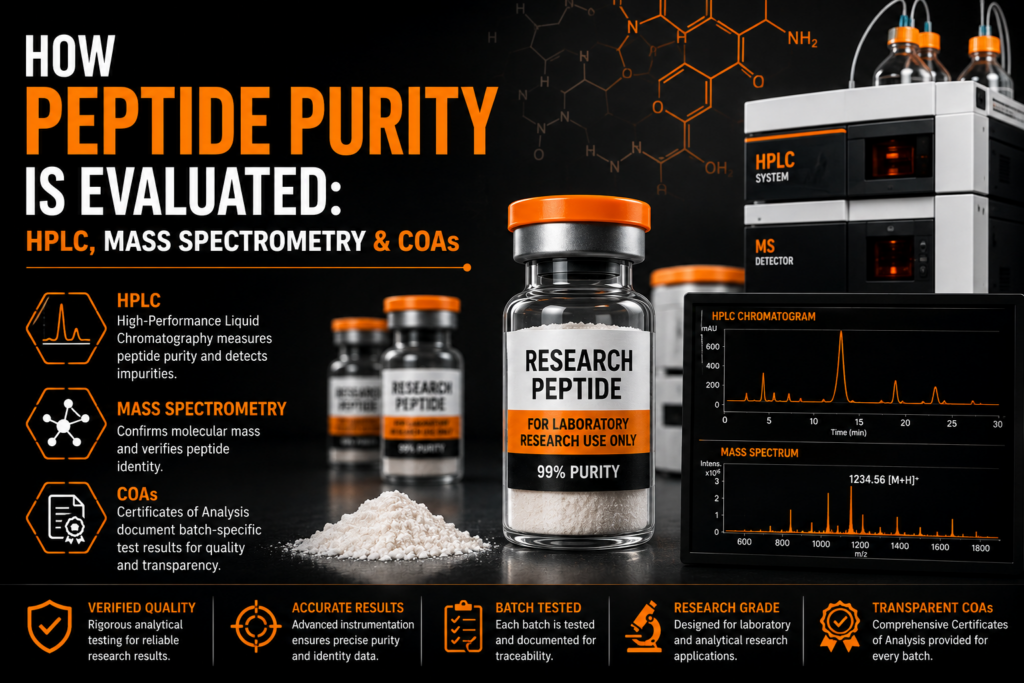
How Peptide Purity Is Evaluated: HPLC, Mass Spectrometry & COAs
When evaluating research peptides, purity is one of the most frequently discussed characteristics. However, a percentage displayed beside a product does not tell the complete analytical story.
Researchers may need to consider how the material was tested, whether its molecular identity was evaluated, which analytical method was used, which batch was tested, and whether the supporting documentation corresponds to the material being examined.
This guide from Peptide Sciences explains the roles of high-performance liquid chromatography, mass spectrometry, Certificates of Analysis, batch identification, and other factors relevant to the analytical evaluation of peptide research materials.
What Does Peptide Purity Mean?
In analytical chemistry, purity generally describes how much of the detected material corresponds to the intended compound compared with detectable impurities or related components under the conditions of a particular analytical method.
That definition is important because a purity result is connected to the method used to generate it.
A statement such as “99% purity” should therefore not be interpreted as a complete description of molecular identity, concentration, sterility, potency, stability, or every possible characteristic of a sample.
Different analytical questions require different analytical techniques.
For broader biochemical terminology, researchers can also review the general structure and definition of a peptide.
Why Is Analytical Characterization Important for Research Peptides?
Research depends on knowing as much as reasonably possible about the material being investigated.
If an experimental compound contains substantial unintended components, has been incorrectly identified, or differs significantly from its expected molecular structure, laboratory results may become more difficult to interpret or reproduce.
Analytical characterization can therefore help researchers answer different questions about a peptide sample, including:
- Does the sample contain a dominant intended component?
- Are additional detectable components present?
- Does the observed molecular mass correspond with the expected peptide?
- Is the documentation associated with the correct product or batch?
- Which analytical method generated the reported result?
- When was the material analyzed?
No single analytical test necessarily answers every one of these questions.
What Is HPLC?
High-performance liquid chromatography, commonly abbreviated as HPLC, is an analytical separation technique widely used in chemical and pharmaceutical research.
In peptide analysis, chromatography can separate components of a sample based on how they interact with the chromatographic system.
The resulting chromatogram displays detected signals as peaks. Under suitable conditions, the primary peptide component may produce a dominant peak while additional components may generate other detectable peaks.
How Does HPLC Help Evaluate Peptide Purity?
One common use of HPLC is evaluating the relative composition of a peptide preparation.
Chromatographic software can integrate detected peaks and calculate their relative areas. This information may be used to estimate chromatographic purity under the specific conditions of the method.
For example, if the principal component accounts for the large majority of integrated detectable peak area, the chromatographic analysis may report a correspondingly high relative purity.
However, the result should be interpreted within the context of the analytical method.
HPLC Purity Is Not the Same as Complete Product Characterization
A common mistake is assuming that an HPLC percentage proves everything about a peptide.
It does not.
An HPLC result primarily describes what was observed under a particular chromatographic method and detection system.
Additional questions may remain regarding:
- Molecular identity
- Exact molecular mass
- Sequence confirmation
- Concentration
- Water content
- Counterions
- Residual solvents
- Microbiological properties
- Stability
- Other method-specific impurities
For this reason, chromatographic purity should be viewed as one piece of analytical information rather than a universal quality measurement.
What Does an HPLC Chromatogram Show?
An HPLC chromatogram is a graphical representation of detector response over time as components move through the chromatographic system.
Each detectable component may appear as a peak depending on the method and detector.
Researchers reviewing a chromatogram may consider:
- The size of the principal peak
- The number of additional detected peaks
- Retention times
- Peak separation
- Integration method
- Detector used
- Analytical conditions
A chromatogram can therefore provide more context than simply displaying a purity percentage without supporting analytical information.
What Is Mass Spectrometry?
Mass spectrometry, or MS, is an analytical technique used to measure ions according to their mass-to-charge characteristics.
In peptide research, mass spectrometric methods can provide information relevant to molecular mass and compound characterization.
This makes mass spectrometry useful alongside chromatographic techniques because it can address analytical questions that a simple chromatographic purity percentage does not answer by itself.
HPLC vs Mass Spectrometry: What Is the Difference?
HPLC and mass spectrometry are complementary analytical tools rather than interchangeable tests.
A simplified way to understand the distinction is:
- HPLC: helps separate components and evaluate the relative chromatographic composition of a sample.
- Mass spectrometry: provides information about molecular mass and can support molecular identification or characterization.
When chromatography and mass spectrometry are combined, researchers can obtain both separation information and mass-based analytical data.
Methods such as liquid chromatography-mass spectrometry, or LC-MS, are therefore widely used in modern analytical laboratories.
Why Can HPLC and Mass Spectrometry Be Used Together?
Imagine that chromatography shows one dominant peak.
That result can indicate that one component represents a large proportion of the detected chromatographic material, but it does not automatically establish that the component is the intended peptide.
Mass spectrometric information can provide another layer of evidence by comparing observed molecular characteristics with those expected for the compound.
Using complementary analytical approaches can therefore provide a more informative picture than relying on one number alone.
What Is LC-MS?
Liquid chromatography-mass spectrometry combines chromatographic separation with mass spectrometric detection.
The chromatography portion separates components of a sample, after which the mass spectrometer can provide mass-related information about selected components.
LC-MS methods are used across analytical science for applications involving identification, characterization, quantification, and impurity investigation.
The exact capabilities depend on the instrumentation, sample, method, detector configuration, and experimental design.
What Is a Certificate of Analysis?
A Certificate of Analysis, commonly abbreviated as COA, is a document used to report analytical information associated with a material or batch.
The usefulness of a COA depends on the information it actually contains.
Researchers should not treat the words “Certificate of Analysis” as proof by themselves. Instead, they should examine the underlying information presented on the document.
What Should Researchers Look for on a Peptide COA?
A useful peptide COA may include information such as:
- Product or compound name
- Batch or lot identifier
- Date of analysis
- Analytical method
- Reported purity result
- Mass spectrometric information where applicable
- Expected molecular characteristics
- Observed analytical results
- Laboratory identification
- Associated chromatograms or spectra where available
Not every laboratory uses the same COA format, so researchers should focus on whether the documentation provides meaningful analytical information that can be associated with the material being evaluated.
Why Does Batch Identification Matter?
A testing document becomes substantially more useful when researchers can determine which physical batch it represents.
Consider a laboratory that produces or receives multiple batches of the same research peptide.
Testing one batch does not automatically characterize every future batch indefinitely.
Connecting analytical documentation to a batch or lot identifier helps establish traceability between the tested sample and the material supplied for research.
Researchers should therefore distinguish between general example testing and documentation associated with a specific batch.
What Are Peptide-Related Impurities?
Synthetic peptide materials can contain related substances originating from synthesis, purification, handling, degradation, or storage.
Possible peptide-related variations can include sequences or structures that differ from the intended product.
Depending on the synthesis process and analytical method, researchers may investigate materials associated with:
- Incomplete sequences
- Modified sequences
- Deletion products
- Other peptide-related components
- Degradation products
- Residual process-related materials
The specific impurities that matter depend on the compound, synthesis route, purification process, storage conditions, and intended analytical question.
Does 99% HPLC Purity Mean the Sample Is 99% Peptide by Weight?
Not necessarily.
Chromatographic area percentage and total sample composition are not automatically identical measurements.
A vial may contain components that are not represented in the same way by a particular chromatographic detector or integration method.
Researchers should therefore determine exactly what a stated percentage represents before interpreting it as a total compositional measurement.
Does High Purity Prove Peptide Identity?
No.
Purity and identity are related but separate analytical questions.
A sample can produce a dominant chromatographic peak without the chromatogram alone establishing every structural characteristic of the compound represented by that peak.
This is one reason identity-focused analytical information, including appropriate mass spectrometric characterization, can be valuable alongside chromatographic analysis.
Does a COA Guarantee Research Results?
No analytical document can guarantee the outcome of a scientific experiment.
A COA can provide information about characteristics of the tested material, but experimental results may also depend on factors such as:
- Research design
- Sample preparation
- Storage
- Experimental controls
- Instrumentation
- Reagents
- Laboratory procedures
- Biological model
- Statistical interpretation
Analytical documentation should therefore support good research practice rather than replace it.
Peptide Stability Can Affect Analytical Results
Researchers should also consider what happens to a peptide after synthesis and testing.
Chemical materials can change over time, and peptide stability may be influenced by molecular structure and environmental conditions.
Factors that may be relevant include:
- Temperature
- Moisture
- Light exposure
- Oxidative conditions
- Repeated handling
- Storage duration
- Formulation
Consequently, analytical information from a particular point in time should be interpreted together with appropriate storage and handling information.
Purity vs Potency vs Identity
These terms should not be used interchangeably.
Purity
Purity generally concerns the proportion of the intended or principal component relative to detectable additional components under a defined analytical method.
Identity
Identity asks whether the material corresponds to the intended compound.
Potency
Potency concerns the strength or activity of a material under an appropriate assay and context.
A chromatographic purity result should therefore not automatically be described as evidence of potency.
Why Researchers Should Look Beyond Marketing Claims
Statements such as “ultra pure,” “pharmaceutical grade,” “highest quality,” or similar promotional descriptions provide limited scientific value when they are not supported by clearly defined specifications and appropriate documentation.
Researchers can make more informed evaluations by looking for specific and verifiable information instead.
Useful questions include:
- What compound was tested?
- Which batch was analyzed?
- Which analytical method was used?
- What did the method measure?
- Does the documentation include supporting analytical data?
- Does the molecular information correspond to the intended compound?
- Is the documentation current and connected to the material being evaluated?
How Peptide Sciences Organizes Research Products
Peptide Sciences organizes research materials by molecular and experimental category so researchers can compare related compounds without assuming they are identical.
Researchers can browse the complete research peptide catalog or explore individual categories covering metabolic research, growth-hormone pathways, cognitive research, tissue-response research, collagen science, bioregulators, reproductive endocrinology, immune signaling, and other specialized research areas.
Those new to the subject can also begin with our guide, What Are Research Peptides? A Laboratory Research Guide, before exploring individual molecular compounds.
Questions to Ask When Reviewing Peptide Testing
Before relying on a peptide testing document, researchers may find it useful to ask:
- Is the product clearly identified?
- Is there a batch or lot number?
- When was the test performed?
- Was HPLC, UHPLC, LC-MS, mass spectrometry, or another method used?
- What exactly does the reported percentage represent?
- Is molecular identity addressed separately from purity?
- Are chromatograms or spectra available?
- Can the document be connected to the material being evaluated?
These questions provide much more useful context than simply looking for the highest percentage printed on a webpage.
Frequently Asked Questions About Peptide Purity Testing
What is HPLC peptide testing?
HPLC is a chromatographic technique used to separate components within a sample. In peptide analysis, it can help researchers evaluate the relative chromatographic composition and detect additional components under the conditions of the method.
Can HPLC identify a peptide?
Chromatographic behavior can contribute analytical information, but HPLC purity alone should not be treated as complete molecular identification. Additional techniques may be used when identity confirmation is required.
Why is mass spectrometry used for peptides?
Mass spectrometry provides molecular mass-related information and can support peptide characterization. It complements chromatographic methods that focus on separation and relative composition.
What is the difference between HPLC and LC-MS?
HPLC primarily provides chromatographic separation and detection, while LC-MS couples liquid chromatographic separation with mass spectrometric analysis, allowing researchers to obtain additional mass-related information about detected components.
What is a peptide COA?
A peptide Certificate of Analysis is documentation reporting analytical information associated with a material or batch. Depending on the testing performed, it may include purity, chromatographic data, mass-related information, batch identifiers, and other specifications.
Does a 99% purity result mean a peptide is safe?
No. An analytical purity percentage does not by itself establish safety, clinical suitability, sterility, therapeutic efficacy, or approval for human use. It describes a specific analytical characteristic under a defined testing method.
Why should a COA include a batch number?
Batch identification improves traceability by helping researchers determine which material the analytical document is intended to represent.
Final Thoughts on Peptide Purity
Peptide purity should be evaluated as part of a broader analytical picture.
HPLC can provide valuable information about chromatographic composition. Mass spectrometry can provide complementary information relating to molecular mass and identity. A properly associated Certificate of Analysis can help organize and communicate those analytical findings.
Rather than relying on one purity percentage, researchers should consider the compound identity, analytical methodology, batch traceability, supporting data, storage conditions, and scientific purpose of the material.
Researchers can browse research peptides and laboratory compounds by category to compare the molecular identities and research contexts of individual products.
Research Use Only: Products and compounds discussed in this educational guide are intended strictly for laboratory, analytical, identification, and scientific research purposes. Analytical terminology presented here should not be interpreted as a guarantee of safety, efficacy, therapeutic suitability, or authorization for human or animal use.
