
Uncategorized
Research Peptides
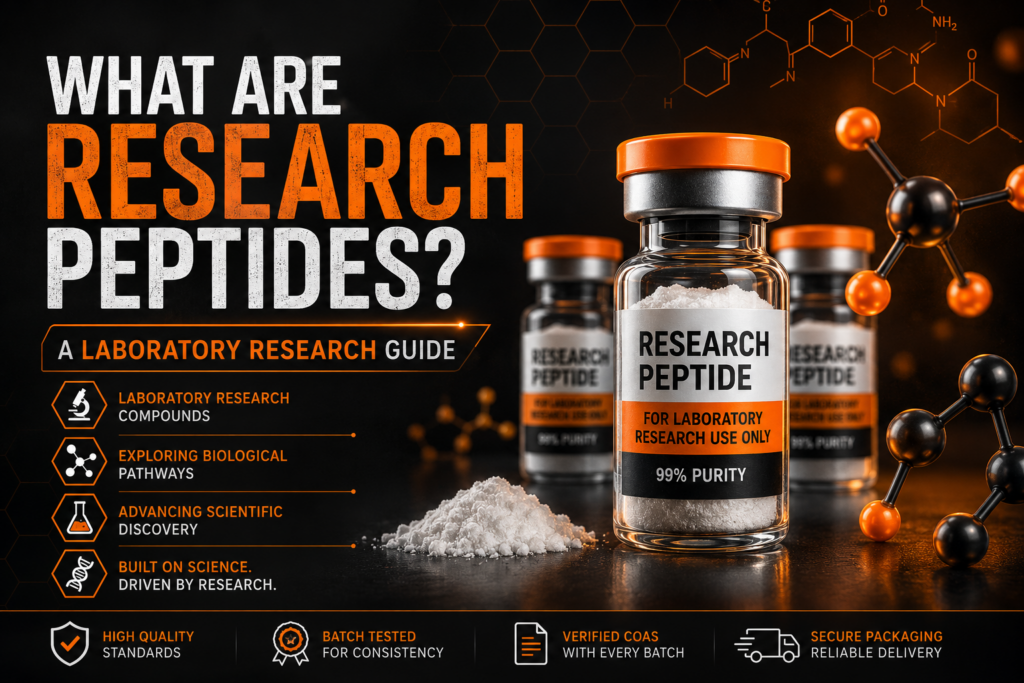
What Are Research Peptides? A Laboratory Research Guide
Research peptides are short chains of amino acids studied in controlled laboratory environments to investigate biological signaling, receptor activity, cellular communication, metabolic pathways, neuroendocrine systems, tissue biology, and other biochemical processes.
Because different peptide sequences can interact with very different biological pathways, peptides have become useful research tools across fields including molecular biology, endocrinology, neuroscience, metabolism, immunology, dermatological science, and cellular research.
This guide from Peptide Sciences explains what research peptides are, why scientists study them, how different peptide families vary, and what researchers should consider when evaluating peptide materials for laboratory investigations.
What Is a Peptide?
A peptide is a chain of amino acids connected through peptide bonds. Amino acids are fundamental molecular building blocks involved in the formation of peptides and proteins.
For broader biochemical background, researchers can review the general definition and structure of a peptide.
Peptides can vary significantly in length, sequence, structure, chemical modification, molecular weight, receptor affinity, and biological function. These differences are important because two compounds described broadly as research peptides may interact with completely different molecular systems.
The distinction between a peptide and a protein is not determined by one universally accepted numerical cutoff. In general, peptides tend to consist of shorter amino-acid chains, while proteins are typically larger molecules capable of forming more complex three-dimensional structures.
What Are Research Peptides Used to Study?
Research peptides are used as experimental materials for investigating specific biochemical mechanisms.
Depending on the compound, researchers may study interactions involving cell-surface receptors, intracellular signaling pathways, gene expression, neurotransmitter systems, metabolic regulation, extracellular-matrix biology, immune signaling, endocrine communication, or other molecular processes.
The scientific value of a research peptide therefore depends on its individual structure and experimental context rather than simply the fact that it belongs to the broader peptide class.
For example, a peptide studied in connection with melanocortin receptors represents a different research model from one associated with growth-hormone signaling, collagen biology, incretin receptors, reproductive endocrinology, or neurotrophic pathways.
Major Categories of Research Peptides
The modern research-peptide field includes numerous molecular families and experimental applications. Organizing compounds by their primary research context can make it easier for laboratories to compare related materials without treating them as interchangeable.
Growth Hormone Peptides
Growth hormone peptides are investigated in laboratory models involving growth-hormone-releasing pathways, pituitary signaling, growth hormone secretagogue receptors, GHRH-associated mechanisms, and IGF-related biology.
This research area includes different molecular classes such as growth-hormone-releasing hormone analogs and growth hormone secretagogues.
Although several compounds may ultimately be studied within the broader growth-hormone axis, their receptor interactions and molecular structures can differ substantially. Researchers should therefore evaluate each compound independently.
Metabolic Research Peptides
Weight loss and metabolic research peptides are investigated in experimental systems involving appetite signaling, glucose regulation, incretin pathways, adipose biology, lipid metabolism, energy homeostasis, and neuroendocrine regulation.
This area includes several distinct receptor models.
Semaglutide, for example, is associated primarily with GLP-1 receptor research. Tirzepatide provides a model involving GIP and GLP-1 receptors, while Retatrutide has attracted research interest because of its activity involving GIP, GLP-1, and glucagon receptor pathways.
Other metabolic research compounds may involve amylin-associated signaling, growth-hormone-derived fragments, adipose-associated pathways, or central nervous-system mechanisms.
Healing & Tissue-Response Research Peptides
Peptides for healing research are studied in laboratory models involving cellular migration, extracellular-matrix signaling, tissue-response mechanisms, vascular biology, cytoskeletal organization, and inflammatory pathways.
Compounds such as BPC-157 and TB-500 are frequently discussed together within this research area, but they are distinct molecular subjects and should not be described as if they operate through identical mechanisms.
Other compounds in tissue-response research may involve mitochondrial signaling, epithelial biology, innate immune pathways, fibrosis-associated mechanisms, or cellular stress responses.
Nootropic & Cognitive Research Peptides
Nootropic peptides are investigated in neuroscience research involving neuronal signaling, synaptic plasticity, neurotrophic pathways, neurotransmitter regulation, stress responses, and cognitive-associated mechanisms.
Research compounds within this group include molecules such as Semax, Selank, P21, FGL-S, and other neuroactive research materials.
Even when several compounds appear within the same cognitive research category, their molecular structures and proposed experimental mechanisms can differ considerably.
Collagen & Dermal Research Peptides
Peptide research also plays an important role in studies involving skin biology, fibroblasts, extracellular-matrix organization, collagen-associated signaling, pigmentation, and cosmetic science.
Collagen peptides may be investigated in relation to collagen synthesis pathways, fibroblast behavior, extracellular-matrix signaling, and structural-protein biology.
Other dermal peptide families may involve copper peptides, palmitoylated peptides, pigmentation-associated sequences, topical signaling peptides, or cosmetic research compounds.
Separating collagen, cosmetic, and skin research categories helps preserve the scientific differences between these materials.
Bioregulator Peptides
Bioregulator peptides represent a specialized group of short peptide sequences studied in connection with cellular signaling, gene-expression models, regulatory pathways, and organ-associated biological systems.
Research materials in this category include compounds such as Pinealon, Cardiogen, Vilon, Vesugen, Chonluten, Cortagen, and other short-peptide research sequences.
Immune & Thymic Peptide Research
Some research peptides are studied primarily in connection with immune signaling and thymic biology.
Experimental areas may include cytokine-associated pathways, lymphocyte biology, thymic signaling, innate and adaptive immune mechanisms, and broader immunoregulatory processes.
The immune support peptide research collection organizes compounds associated with these laboratory investigations.
Reproductive & Neuroendocrine Research Peptides
Peptides are also important tools for studying reproductive endocrinology.
The sexual health and reproductive research peptide collection includes compounds associated with Kisspeptin signaling, gonadotropin-releasing hormone pathways, pituitary communication, oxytocin signaling, and the hypothalamic-pituitary-gonadal axis.
Kisspeptin-10, Gonadorelin, Triptorelin, and Oxytocin provide examples of compounds that can represent different points within neuroendocrine signaling networks.
Why Molecular Structure Matters in Peptide Research
One of the most important principles in peptide science is that compounds within the same broad research category should not automatically be treated as interchangeable.
Small changes in amino-acid sequence, chemical modification, terminal structure, lipid attachment, molecular length, or other characteristics can influence stability, receptor affinity, and experimental behavior.
Consider several examples.
Semaglutide, Tirzepatide, and Retatrutide may all appear within metabolic research, yet they represent different receptor profiles.
Semax and Selank may both be investigated within neuroscience, but they are different compounds associated with different areas of neurobiological research.
GHK-Cu and Matrixyl may both appear in dermal science, while representing different peptide structures and research pathways.
BPC-157 and TB-500 may both appear within tissue-response discussions, but their molecular identities and experimental research contexts remain distinct.
Useful scientific content should preserve these differences rather than applying identical descriptions to every peptide within a category.
How Are Research Peptides Evaluated?
Researchers should evaluate more than a product name when selecting laboratory material.
Depending on the experimental requirements, relevant considerations may include:
- Molecular identity
- Amino-acid sequence
- Molecular weight
- Formulation
- Labeled quantity or concentration
- Analytical documentation
- Batch identification
- Storage information
- Relevant scientific literature
- Appropriate experimental controls
Understanding these characteristics helps researchers distinguish between compounds that may share similar commercial terminology while representing different molecular materials.
Peptide Purity & Analytical Testing
Analytical testing is an important part of peptide characterization.
However, researchers should avoid evaluating a material solely by a purity percentage displayed on a product page. Understanding how the material was analyzed is also important.
High-Performance Liquid Chromatography
High-performance liquid chromatography, commonly abbreviated as HPLC, is frequently used to separate and evaluate components within peptide samples.
A chromatographic result can provide information about the relative composition of a sample, but researchers should consider the methodology and supporting documentation when interpreting analytical results.
Mass Spectrometry
Mass spectrometry provides another analytical approach and can be used to investigate molecular mass and identity.
HPLC and mass spectrometry answer related but different analytical questions. Using multiple analytical techniques may provide a more complete characterization than relying on a single measurement.
Certificates of Analysis
A Certificate of Analysis, commonly called a COA, may summarize analytical information associated with a particular compound or batch.
Researchers should examine what a COA actually reports rather than assuming that the existence of a document automatically proves every possible aspect of product quality.
Useful documentation should clearly identify the material, relevant batch information, analytical method, and reported result.
What Are Lyophilized Peptides?
Many research peptides are supplied in lyophilized form.
Lyophilization is a process in which water is removed from a material under controlled conditions. This approach is commonly used with laboratory materials where limiting moisture may support stability during storage and transportation.
However, not every peptide has identical stability characteristics.
Factors such as temperature, moisture, light exposure, repeated handling, molecular structure, and storage duration may influence laboratory materials differently.
Researchers should therefore follow compound-specific information and established laboratory procedures rather than assuming one handling standard applies universally across all peptides.
Research Peptides vs Proteins
Peptides and proteins are both constructed from amino acids, but they generally differ in size and structural complexity.
Proteins often contain larger amino-acid sequences capable of folding into complex three-dimensional structures. Peptides tend to be shorter chains and may serve as signaling molecules, fragments, hormones, receptor ligands, or experimental analogs.
The boundary between a peptide and a protein is not absolute, so molecular identity should be evaluated based on the actual compound rather than relying entirely on terminology.
Research Peptides vs Finished Therapeutic Products
A laboratory research compound should not automatically be treated as equivalent to a finished pharmaceutical or approved therapeutic product.
The appearance of a molecule within published scientific or clinical literature does not establish that every commercially available research version has been evaluated, manufactured, or approved for human therapeutic use.
Research materials should therefore be represented according to their actual intended purpose, molecular identity, specifications, and available documentation.
Claims about treatment, disease prevention, diagnosis, human performance, or guaranteed biological outcomes should not be substituted for accurate scientific descriptions.
Why Research Categories Matter
Organizing research peptides by molecular and biological context can help both researchers and search engines understand relationships between compounds.
Instead of placing every material under one generic peptide label, Peptide Sciences organizes products according to research areas such as:
- Growth hormone signaling
- Metabolic and incretin research
- Tissue-response research
- Cognitive and neuroscience research
- Bioregulator research
- Collagen and dermal biology
- Cosmetic peptide science
- Immune signaling
- Melanocortin research
- Reproductive endocrinology
- Sleep and circadian research
- Specialized peptide research
This structure makes it easier to move from a broad research topic to a category and then to individual molecular compounds.
How to Compare Research Peptides
Researchers comparing peptide materials should begin with the scientific question rather than simply selecting the most commonly discussed compound.
Useful questions may include:
- Which biological pathway is being investigated?
- Which receptor or cellular mechanism is relevant?
- What is the exact molecular identity of the compound?
- Does the research require a single-receptor or multi-receptor model?
- What analytical information is available?
- What experimental controls are required?
- Is the product format appropriate for the intended laboratory protocol?
- What does the existing scientific literature establish?
- Which claims remain experimental or uncertain?
These questions help create more controlled and scientifically meaningful comparisons.
Building Reliable Peptide Research
Reliable laboratory research depends on more than selecting a familiar compound name.
Good experimental design may require verified molecular identity, suitable analytical characterization, appropriate controls, responsible storage, accurate documentation, careful interpretation of published literature, and reproducible methodology.
Researchers should also distinguish established scientific information from hypotheses, preclinical findings, preliminary observations, and unsupported marketing claims.
This distinction becomes particularly important when peptide research overlaps with topics related to human health.
Explore Research Peptides by Category
Peptide Sciences provides a structured catalog designed to help researchers compare compounds according to their primary scientific context.
Researchers can browse the complete research peptide catalog or navigate through individual categories to compare molecular compounds, formulations, concentrations, and research areas.
Starting with the appropriate research category can help narrow a large catalog into compounds relevant to a particular biological pathway or experimental question.
Frequently Asked Questions About Research Peptides
What are research peptides?
Research peptides are amino-acid-based compounds supplied for scientific and laboratory investigation. Different peptides may be studied for receptor signaling, cellular communication, metabolic pathways, neuroscience, endocrine biology, extracellular-matrix research, immune signaling, and other biochemical processes.
Are all research peptides the same?
No. Peptides can differ in sequence, molecular size, chemical modification, receptor affinity, stability, formulation, and research application. Two products belonging to the same category may still represent very different experimental models.
Why are peptides studied in laboratories?
Peptides can interact with specific biological pathways, making them useful experimental tools for investigating receptor activity, cellular signaling, hormone pathways, molecular communication, and other biochemical mechanisms.
What does peptide purity mean?
Purity generally refers to the proportion of the intended compound relative to other detectable components under a particular analytical method. Researchers should consider the testing methodology and identity information rather than relying exclusively on a single percentage.
What is a peptide COA?
A Certificate of Analysis is documentation that may summarize analytical information associated with a specific product or batch. Researchers should examine which methods were used, what was measured, and whether the documentation clearly corresponds to the material being evaluated.
Where can researchers browse different peptide categories?
Researchers can visit the Peptide Sciences shop to browse the complete catalog or navigate directly to categories covering metabolic, growth hormone, healing, cognitive, collagen, bioregulator, immune, reproductive, cosmetic, and other research areas.
Research Use Only: Products and compounds discussed in this guide are intended strictly for laboratory, analytical, identification, and scientific research purposes. References to biological pathways describe areas of scientific investigation and should not be interpreted as medical advice, instructions for human or animal use, treatment recommendations, or therapeutic claims.
