
Uncategorized
Peptide Certificate Of Analysis
Aug
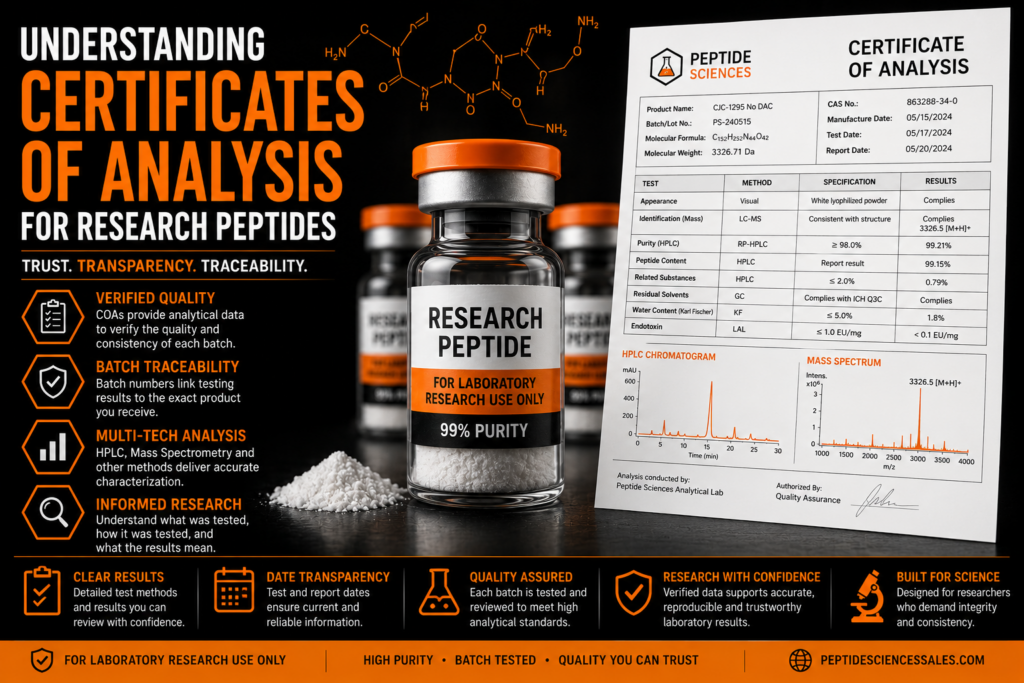
Understanding Certificates of Analysis for Research Peptides
A peptide Certificate of Analysis, commonly abbreviated as COA, is a document used to communicate analytical information associated with a particular material or batch.
For researchers evaluating peptide materials, a COA can provide useful information about identity, analytical testing, reported purity, batch traceability, testing dates, and other specifications. However, the value of a COA depends on what was actually tested, how the testing was performed, and whether the document can be connected to the material being evaluated.
This guide from Peptide Sciences explains what researchers should look for when reviewing peptide Certificates of Analysis, how batch numbers support traceability, why HPLC and mass spectrometry may appear on a COA, and which conclusions should not be drawn from analytical documentation alone.
What Is a Peptide Certificate of Analysis?
A Certificate of Analysis is a document that reports analytical or specification-related information about a material.
For peptide-related materials, a COA may identify the compound and batch while listing tests performed and the corresponding results.
Depending on the material and testing program, a COA may include information relating to:
- Product or compound name
- Batch or lot number
- Date of analysis
- Date of release
- Analytical methods
- Acceptance criteria
- Reported results
- Chromatographic purity
- Mass-related analytical data
- Molecular characteristics
- Laboratory or manufacturer identification
- Authorized review or approval
FDA’s Good Manufacturing Practice guidance for active pharmaceutical ingredients states that Certificates of Analysis should identify the material and batch, list tests performed, include applicable acceptance limits and numerical results, and be dated and signed by authorized quality personnel.
For general biochemical background on the molecular class discussed throughout this guide, researchers can also review the definition of a peptide.
Why Are COAs Important in Peptide Research?
Scientific research depends heavily on knowing what material is being studied.
If a researcher cannot establish which compound or batch a testing document represents, the analytical result becomes less useful for evaluating the material used in an experiment.
A well-structured COA can support several important research functions:
- Connecting analytical results to a particular batch
- Identifying which tests were performed
- Showing reported results rather than marketing descriptions
- Providing a record that can be compared with product specifications
- Supporting laboratory documentation and traceability
A COA should therefore be viewed as part of a broader analytical record rather than simply a badge displayed beside a product.
Why Batch Numbers Matter
One of the most important pieces of information on a Certificate of Analysis is the batch or lot number.
A batch identifier helps connect a physical material with the manufacturing and testing records intended to represent it.
Consider a peptide that is produced multiple times during the year.
Although each production run may use the same product name, individual batches may have different dates, analytical results, impurity profiles, or other characteristics.
A test performed on one batch should not automatically be assumed to represent every future batch.
FDA guidance likewise treats batch identification as an important part of Certificates of Analysis and laboratory records.
What Should Researchers Look for on a Peptide COA?
A useful COA should provide enough information for a researcher to understand what material was analyzed and what the reported results mean.
The following sections explain some of the most important fields.
1. Compound Name
The document should clearly identify the material being tested.
This matters because peptide names can sometimes be similar while representing different sequences, fragments, analogs, modifications, or formulations.
Researchers should compare the name on the COA with the material actually being evaluated.
2. Batch or Lot Number
The batch identifier should correspond with the product or container associated with the testing documentation.
Without this connection, it may be difficult to determine whether the COA applies to the material in question.
3. Test Date
The testing date provides context regarding when the analytical evaluation was performed.
This can be particularly important when reviewing materials that may be affected by stability over time.
Researchers interested in this topic can read Lyophilized Peptides: Stability, Storage & Laboratory Handling.
4. Analytical Method
A result becomes more informative when the document identifies how it was generated.
For example, a chromatographic purity result should indicate that an appropriate chromatographic method was used rather than presenting a percentage without analytical context.
Common analytical techniques associated with peptide characterization may include:
- HPLC
- UHPLC
- Mass spectrometry
- LC-MS
- Other compound-specific methods
FDA analytical-method guidance emphasizes that analytical procedures should be suitable for their intended purpose and that reference materials may require multiple or orthogonal techniques for characterization.
5. Reported Result
The COA should report the result produced by the analytical method.
If a specification includes an acceptance criterion, researchers should be able to compare the result with that criterion.
For numerical tests, FDA Q7 guidance recommends listing both acceptance limits and the numerical results obtained.
What Does Purity on a COA Mean?
Purity is often one of the first values researchers look for on peptide analytical documentation.
However, a purity percentage should always be interpreted according to the method used to generate it.
A chromatographic purity result typically represents the relative detector response of the principal component compared with other detected components under defined analytical conditions.
It should not automatically be interpreted as a complete measurement of every material present in a vial.
For a detailed explanation, see Peptide Purity Testing: HPLC, Mass Spectrometry & COAs.
HPLC Results on Peptide COAs
High-performance liquid chromatography, commonly abbreviated as HPLC, is frequently used when evaluating peptide purity and impurities.
The method separates components of a sample under defined chromatographic conditions.
A detector records signals as material passes through the system, producing a chromatogram containing peaks.
The relative areas of these peaks may then be used to calculate chromatographic purity.
What Should Accompany an HPLC Result?
When reviewing HPLC information, researchers may look for:
- The reported purity percentage
- Chromatogram where available
- Main peak
- Additional detected peaks
- Retention-time information
- Method identification
- Sample or batch identification
A percentage by itself provides substantially less information than a result connected to the method, chromatogram, and batch tested.
Mass Spectrometry on a COA
Mass spectrometry provides a different type of analytical information.
Rather than primarily separating components according to chromatographic behavior, mass spectrometry measures ions according to their mass-to-charge characteristics.
This information can support molecular characterization and help researchers compare observed mass-related data with what is expected for a particular compound.
USP materials on synthetic peptide characterization describe chromatography and mass spectrometry among the analytical approaches used for peptide identity and quality assessment.
Why HPLC and Mass Spectrometry Are Different
A strong analytical approach recognizes that purity and identity are separate questions.
For example:
- HPLC can help evaluate chromatographic composition and detect additional components.
- Mass spectrometry can provide molecular mass-related information supporting characterization.
A sample could theoretically produce one dominant chromatographic peak while still requiring additional analytical information to establish molecular identity.
This is why multiple complementary analytical methods may be useful when characterizing peptide materials.
What Is LC-MS?
Liquid chromatography-mass spectrometry, commonly written as LC-MS, combines chromatographic separation with mass spectrometric analysis.
The chromatography stage separates components before mass-related information is collected.
This can make LC-MS useful when researchers want to investigate both separation behavior and molecular characteristics within the same analytical workflow.
What Are Acceptance Criteria?
An analytical result is easier to interpret when there is a predefined specification or acceptance criterion.
For example, a specification may define an acceptable range or threshold for a particular characteristic.
The laboratory result can then be compared with that requirement.
A COA that simply says “Pass” without showing what was tested or what limit was applied provides less analytical transparency than documentation showing:
- The test performed
- The specification or acceptance criterion
- The observed result
FDA Q7 guidance specifically describes Certificates of Analysis as listing applicable tests, acceptance limits, and numerical results where tests produce numerical outcomes.
What Does “Pass” Mean on a COA?
When a COA states that a characteristic passes, the intended meaning is generally that the reported result met a defined specification.
Researchers should still determine:
- Which characteristic was tested?
- What method was used?
- What acceptance criterion applied?
- What result was obtained?
A pass statement becomes more informative when these details are available.
Should a COA Include the Testing Laboratory?
Identifying who performed an analysis can improve traceability.
FDA’s Q7 guidance states that Certificates of Analysis should identify the original manufacturer and, in certain repacking or third-party analysis situations, identify the laboratory that performed the analysis.
For researchers, this information provides additional context when evaluating documentation.
Third-Party Testing vs Internal Testing
Analytical testing may be performed internally or by an independent laboratory.
The location of the testing alone does not determine whether a result is scientifically useful.
Researchers should instead evaluate:
- Which analytical method was used
- Whether the sample can be connected to a batch
- Whether results are clearly reported
- Whether suitable standards and controls were used
- Whether supporting analytical data are available
A third-party laboratory name by itself should not replace evaluation of the actual analytical results.
What Is Batch-Specific Testing?
Batch-specific testing means that analytical documentation can be connected to a particular production lot or batch.
This is different from showing one historical test result as a generic example for every product manufactured afterward.
Batch-specific documentation can improve traceability because researchers can compare the identifier on the material with the identifier on the analytical record.
Why Old COAs May Be Less Informative
Testing documents should be interpreted in relation to the material they represent.
If a COA was produced for an older batch, it should not automatically be presented as analytical proof for a newly manufactured batch unless there is an appropriate documented relationship.
The same principle applies when formulations, manufacturers, production processes, or analytical methods change.
Can a COA Prove a Peptide Is Authentic?
A COA can contribute evidence relevant to molecular identity and quality, but its evidentiary value depends on the analytical methods performed and the traceability of the sample.
A document displaying a product name and purity percentage without meaningful identity testing or batch connection offers less information than documentation supported by appropriate analytical methods.
Researchers should therefore evaluate the underlying testing rather than relying on the appearance of the certificate.
Can a COA Be Fake?
Like any document, a Certificate of Analysis can potentially contain inaccurate, incomplete, altered, or misleading information.
Researchers should therefore evaluate consistency between:
- Product identity
- Batch number
- Testing date
- Laboratory information
- Analytical results
- Supporting chromatograms or spectra
When independent verification is important to an experiment, researchers may choose to conduct appropriate analytical testing using their own laboratory or qualified analytical provider.
Does a COA Prove Safety?
No.
A Certificate of Analysis reports analytical information associated with the tests performed.
It should not automatically be interpreted as proof that a material is safe for human or animal use.
Analytical purity, molecular identity, sterility, toxicity, pharmacological effects, clinical safety, and regulatory approval are different questions.
Does a COA Prove Therapeutic Effectiveness?
No.
Analytical testing does not establish therapeutic effectiveness.
A chromatogram or mass spectrum can provide information about material characteristics, but it does not demonstrate that a compound treats, cures, prevents, or diagnoses a medical condition.
This distinction is particularly important when laboratory research compounds are discussed alongside molecules that also appear in pharmaceutical research.
Does “99% Purity” Mean 99% of Everything in the Vial?
Not necessarily.
If the value comes from chromatographic peak-area analysis, it typically represents the relative response observed through that analytical method.
It does not automatically account for every possible component of a formulation, water content, residual solvents, salts, counterions, or other material characteristics.
Researchers should identify what the number actually represents before interpreting it.
Purity, Identity and Quantity Are Different Measurements
Researchers should avoid treating several analytical concepts as if they mean the same thing.
Purity
Purity concerns the relative presence of the intended or principal component compared with detected additional components under defined analytical conditions.
Identity
Identity concerns whether the material corresponds to the intended compound.
Quantity
Quantity concerns how much material is present.
A high chromatographic purity percentage does not by itself establish the exact quantity of peptide present in a container.
Why Raw Analytical Data Can Add Context
A COA provides a summary of testing.
Supporting analytical outputs such as chromatograms and spectra may provide additional context about how reported values were produced.
FDA Q7 guidance describes laboratory records as including raw data and instrument-generated graphs, charts, and spectra identified to the material and batch tested.
Researchers examining detailed analytical documentation may therefore look beyond the summary number when additional data are available.
COAs and Peptide Stability
Analytical results describe a material at a particular testing point.
They do not automatically establish that the material will remain unchanged indefinitely.
Stability can depend on:
- Temperature
- Moisture
- Light
- Oxygen exposure
- Formulation
- Packaging
- Molecular structure
- Storage duration
FDA Q7 guidance describes ongoing stability testing as a basis for confirming appropriate storage conditions and retest or expiry dates for APIs.
For a deeper explanation, read Lyophilized Peptides: Stability, Storage & Laboratory Handling.
How to Review a Peptide COA Step by Step
Researchers can use the following checklist when reviewing analytical documentation.
Step 1: Confirm the Compound
Check that the product name or molecular identity on the document corresponds to the research material.
Step 2: Check the Batch Number
Compare the batch or lot identifier on the product with the identifier on the COA.
Step 3: Check the Date
Determine when the analysis was performed and whether the documentation is relevant to the current batch.
Step 4: Identify the Tests
Look for the analytical methods used, such as chromatography or mass spectrometry.
Step 5: Review the Results
Determine what each reported number actually represents.
Step 6: Compare With Specifications
If acceptance criteria are provided, determine whether the reported result meets them.
Step 7: Review Supporting Data
Where available, inspect chromatograms, spectra, or additional analytical documentation.
Step 8: Identify the Testing Source
Determine which laboratory or manufacturer is associated with the analysis.
Common Red Flags When Reviewing a COA
Researchers may want to investigate further when analytical documentation lacks basic traceability or context.
Examples can include:
- No batch or lot number
- No test date
- No analytical method
- No reported numerical results
- No identifiable testing laboratory or source
- A purity number with no explanation of the method
- A batch number that does not correspond with the material
- The same document being presented for unrelated products
- Analytical data that cannot reasonably be associated with the listed compound
These observations do not automatically establish that a material is unsuitable, but they can indicate that additional information is needed before drawing strong conclusions from the document.
How COAs Fit Into Good Research Practice
A Certificate of Analysis is most useful when considered alongside other elements of experimental quality control.
Researchers may also need to consider:
- Experimental design
- Reference standards
- Sample preparation
- Instrument calibration
- Storage conditions
- Appropriate controls
- Scientific literature
- Reproducibility
- Independent verification where necessary
FDA’s analytical-method guidance likewise emphasizes suitability of analytical procedures and the use of appropriately characterized reference materials.
Research Peptide Education at Peptide Sciences
Researchers beginning with the fundamentals can read What Are Research Peptides? A Laboratory Research Guide.
For more detail on analytical methods, see Peptide Purity Testing: HPLC, Mass Spectrometry & COAs.
For storage-related considerations, continue with Lyophilized Peptides: Stability, Storage & Laboratory Handling.
Researchers can also browse the Peptide Sciences research catalog to compare products according to their molecular and research categories.
Frequently Asked Questions About Peptide COAs
What does COA stand for?
COA stands for Certificate of Analysis. It is a document used to report analytical or specification-related information associated with a material or batch.
Should a peptide COA have a batch number?
Batch identification is highly useful because it connects analytical results with a particular batch of material. FDA Q7 guidance includes batch identification among the information expected on API Certificates of Analysis.
What does HPLC mean on a peptide COA?
HPLC stands for high-performance liquid chromatography. It is an analytical separation technique commonly used to evaluate chromatographic composition and purity.
What does MS mean on a peptide COA?
MS generally refers to mass spectrometry. Mass spectrometric data can provide information relating to molecular mass and support characterization of a peptide material.
Is HPLC enough to prove peptide identity?
Not necessarily. Chromatography and identity-focused analytical methods answer different questions, which is why complementary techniques can provide stronger characterization.
Does 99% purity mean a peptide is safe?
No. Analytical purity should not be interpreted as proof of safety, clinical suitability, sterility, regulatory approval, or therapeutic effectiveness.
Can the same COA be used for every batch?
A COA should be interpreted according to the batch it represents. Analytical results from one batch should not automatically be assumed to characterize unrelated future batches.
What should researchers check first on a COA?
Begin with the compound name, batch number, testing date, analytical methods, and reported results. These fields help establish whether the document can reasonably be connected to the material being evaluated.
Final Thoughts on Peptide Certificates of Analysis
A Certificate of Analysis can provide valuable analytical information, but the existence of a certificate should not be treated as the end of the evaluation process.
Researchers should examine what material was tested, which batch was analyzed, which methods were used, what the results actually measure, and whether supporting analytical data are available.
Batch traceability, HPLC results, mass spectrometric information, testing dates, acceptance criteria, and laboratory identification can all contribute to understanding the analytical record.
Most importantly, a COA should be interpreted for what it is: a document reporting analytical information—not a guarantee of safety, therapeutic effectiveness, experimental success, or regulatory approval.
Researchers can explore research peptides and laboratory compounds by category through the Peptide Sciences catalog.
Research Use Only: Compounds discussed in this educational guide are intended strictly for laboratory, analytical, identification, and scientific research purposes. This information is provided for general scientific education and should not be interpreted as medical advice, instructions for human or animal use, therapeutic claims, or a guarantee of any specific product characteristic.
