
Uncategorized
GLP-1 research peptides
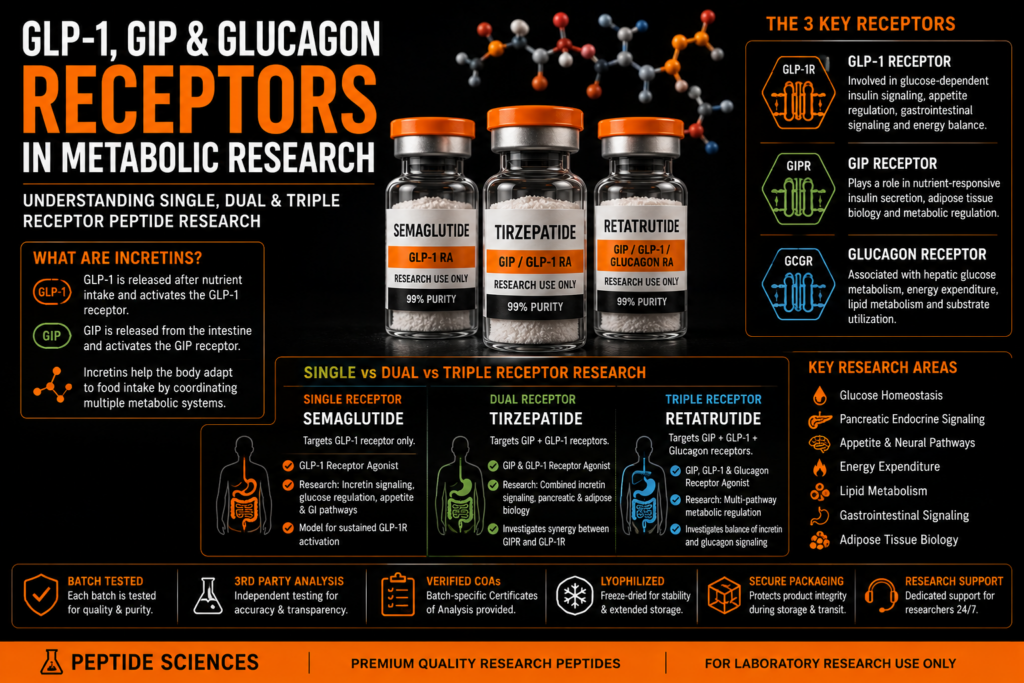
GLP-1, GIP & Glucagon Receptors in Metabolic Research
GLP-1 research peptides have become an important area of metabolic science because they allow researchers to investigate how incretin and glucagon-family receptor signaling influences glucose regulation, energy balance, appetite-associated pathways, pancreatic signaling, and broader metabolic communication.
However, compounds discussed within this research area do not all interact with the same receptors.
Some research compounds primarily target the GLP-1 receptor, while others engage both GIP and GLP-1 receptors. More recent experimental molecules have been designed to investigate three receptor systems within a single molecular framework: GIP, GLP-1, and glucagon receptors.
This guide from Peptide Sciences explains the differences between GLP-1, GIP, and glucagon receptor research, why single-, dual-, and triple-receptor models are scientifically distinct, and how compounds such as Semaglutide, Tirzepatide, and Retatrutide fit into modern metabolic research.
What Are Incretin Hormones?
Incretins are signaling hormones released in response to nutrient intake that participate in metabolic communication between the gastrointestinal system, pancreas, nervous system, and other tissues.
Two of the most important incretin-related signaling systems are:
- Glucagon-like peptide-1, or GLP-1
- Glucose-dependent insulinotropic polypeptide, or GIP
These hormones interact with their own receptors and can influence overlapping but distinct biological pathways.
For general biochemical background on amino-acid signaling molecules, researchers can review the definition of a peptide.
What Is the GLP-1 Receptor?
The GLP-1 receptor, commonly abbreviated as GLP-1R, is a G protein-coupled receptor involved in metabolic and endocrine signaling.
Activation of GLP-1 receptor pathways is investigated in relation to:
- Glucose-dependent pancreatic signaling
- Insulin-associated pathways
- Glucagon regulation
- Gastrointestinal signaling
- Appetite-associated neural pathways
- Energy-homeostasis research
The receptor is therefore an important experimental target when researchers investigate how metabolic signals are coordinated following nutrient exposure.
What Is GLP-1?
GLP-1 is an endogenous peptide hormone produced from the proglucagon precursor.
It acts as a signaling molecule that binds to the GLP-1 receptor.
Natural GLP-1 is rapidly processed in biological systems, which is one reason researchers have investigated modified molecular analogs designed to produce different pharmacological characteristics.
These analogs can be useful experimental tools for studying how prolonged GLP-1 receptor activation differs from short-lived endogenous signaling.
What Is GIP?
GIP stands for glucose-dependent insulinotropic polypeptide.
Like GLP-1, GIP is an incretin hormone involved in nutrient-related metabolic signaling.
GIP interacts primarily with the GIP receptor, commonly abbreviated as GIPR.
Laboratory research involving the GIP receptor may examine:
- Glucose-dependent insulin signaling
- Pancreatic beta-cell communication
- Nutrient-responsive endocrine pathways
- Adipose-associated biology
- Energy-storage signaling
- Interactions between GIP and other incretin systems
Although GLP-1 and GIP are both incretin hormones, they should not be considered identical biological signals.
What Is the GIP Receptor?
The GIP receptor is also a G protein-coupled receptor.
When activated by GIP or an appropriate receptor agonist, it can initiate intracellular signaling pathways associated with metabolic regulation.
One of the major questions in modern metabolic research is how GIP receptor signaling behaves when combined with GLP-1 receptor signaling within the same experimental molecule.
This research question forms the basis for dual-receptor agonist models.
What Is Glucagon?
Glucagon is another peptide hormone produced from the proglucagon system.
It plays an important role in metabolic regulation and is especially associated with pathways that help maintain glucose availability.
Glucagon primarily interacts with the glucagon receptor, abbreviated as GCGR.
What Is the Glucagon Receptor?
The glucagon receptor belongs to the same broad receptor family as GLP-1R and GIPR.
Laboratory investigations involving glucagon receptor signaling may examine:
- Hepatic glucose metabolism
- Glycogen-related pathways
- Energy expenditure
- Lipid metabolism
- Substrate utilization
- Interactions with incretin signaling
This receptor becomes especially interesting when researchers investigate molecules designed to activate glucagon signaling alongside GIP and GLP-1 pathways.
GLP-1 vs GIP vs Glucagon Signaling
Although these three receptor systems participate in metabolic biology, they do not perform identical functions.
A simplified research framework can be understood as follows:
- GLP-1 receptor signaling: investigated heavily in glucose regulation, pancreatic signaling, gastrointestinal communication, and appetite-associated pathways.
- GIP receptor signaling: studied in nutrient-responsive insulin signaling, pancreatic biology, adipose research, and incretin interaction.
- Glucagon receptor signaling: investigated in hepatic glucose pathways, energy availability, lipid metabolism, and energy-expenditure research.
Modern metabolic research increasingly examines what happens when two or three of these receptor pathways are activated by a single molecule.
What Is a Single-Receptor Agonist?
A single-receptor research model primarily focuses on one receptor pathway.
Within incretin research, a GLP-1 receptor agonist provides a useful example.
The advantage of this type of model is that researchers can investigate GLP-1-associated signaling without intentionally introducing GIP or glucagon receptor agonism into the same molecule.
Semaglutide and GLP-1 Receptor Research
Semaglutide is commonly used as an example of a GLP-1 receptor agonist within metabolic research.
Its molecular design allows researchers to investigate sustained GLP-1 receptor activation and downstream metabolic signaling.
Laboratory and clinical research involving Semaglutide has contributed to broader scientific interest in:
- GLP-1 receptor pharmacology
- Glucose-dependent endocrine signaling
- Appetite-associated neural mechanisms
- Gastrointestinal signaling
- Metabolic homeostasis
From a research-classification perspective, Semaglutide is useful because it represents a primarily GLP-1-focused model rather than a dual- or triple-receptor design.
What Is a Dual-Receptor Agonist?
A dual-receptor agonist is designed to activate two receptor systems within the same molecule.
Within incretin research, one of the most important examples is simultaneous GIP and GLP-1 receptor agonism.
This approach allows researchers to investigate whether combined receptor signaling produces biological effects that differ from selective GLP-1 receptor activation.
Tirzepatide and Dual GIP/GLP-1 Research
Tirzepatide is a research subject associated with dual GIP and GLP-1 receptor agonism.
Instead of examining only GLP-1 receptor signaling, Tirzepatide provides a molecular model for investigating interactions between two incretin receptor systems.
Research questions involving Tirzepatide may include:
- How GIPR activation interacts with GLP-1R activation
- Whether dual signaling changes pancreatic responses
- How combined incretin activity influences energy homeostasis
- Differences between selective and dual receptor activation
- How receptor balance influences downstream signaling
Researchers can view Tirzepatide 5mg as one example within the Peptide Sciences metabolic research catalog.
Why Compare Tirzepatide With Semaglutide?
Semaglutide and Tirzepatide are often discussed within the same metabolic research field, but they represent different receptor architectures.
The fundamental research distinction is:
- Semaglutide: primarily GLP-1 receptor agonism
- Tirzepatide: combined GIP and GLP-1 receptor agonism
This difference allows researchers to examine whether adding GIP receptor activity changes downstream biological responses compared with a GLP-1-focused model.
They should therefore not be treated as interchangeable compounds simply because both are studied within metabolic research.
What Is a Triple-Receptor Agonist?
A triple-receptor agonist is designed to interact with three receptor systems within one molecular structure.
In metabolic research, this concept has been extended to molecules combining:
- GIP receptor agonism
- GLP-1 receptor agonism
- Glucagon receptor agonism
This creates a broader experimental model than either selective GLP-1 signaling or dual GIP/GLP-1 signaling.
Retatrutide and Triple-Receptor Research
Retatrutide has been studied as a triple GIP, GLP-1, and glucagon receptor agonist.
Its molecular design makes it useful for investigating how simultaneous activation of three metabolic receptor pathways differs from single- or dual-receptor models.
Researchers may use this type of model to investigate interactions involving:
- Incretin receptor signaling
- Glucagon receptor activity
- Glucose homeostasis
- Lipid-associated pathways
- Energy expenditure
- Appetite-associated signaling
- Multi-receptor pharmacology
Within the Peptide Sciences catalog, researchers can compare Retatrutide 12mg with dual- and single-receptor metabolic research compounds.
Single vs Dual vs Triple Receptor Research
The progression from single- to dual- to triple-receptor designs creates different experimental questions.
Single-Receptor Model
A selective GLP-1 receptor model can help isolate signaling associated primarily with GLP-1R.
Dual-Receptor Model
A combined GIP/GLP-1 model allows researchers to investigate interactions between two incretin receptor systems.
Triple-Receptor Model
A GIP/GLP-1/glucagon receptor model introduces glucagon receptor signaling in addition to the two incretin pathways.
These models should not be ranked simply as “weaker” or “stronger.” They represent different molecular designs and research questions.
Why Receptor Balance Matters
Activating multiple receptors within the same molecule does not necessarily mean that each receptor is activated equally.
Molecular design can influence:
- Binding affinity
- Receptor potency
- Signaling bias
- Exposure duration
- Receptor selectivity
- Tissue response
Researchers should therefore look beyond the number of receptors listed in a compound description.
The relative pharmacological activity at each receptor can be just as important as the number of targets involved.
What Is Receptor Agonism?
An agonist is a molecule that binds to a receptor and activates signaling through that receptor.
After receptor activation, intracellular signaling cascades may influence downstream cellular responses.
For GLP-1R, GIPR, and GCGR, signaling commonly involves G protein-coupled receptor mechanisms and second-messenger pathways.
Experimental outcomes can depend on receptor density, cell type, ligand concentration, exposure time, and other laboratory conditions.
Why Cell Type Matters in Metabolic Research
The same receptor may produce different experimental responses depending on where it is expressed and which intracellular signaling machinery is available.
Researchers studying incretin and glucagon-family receptors may therefore consider:
- Cell type
- Receptor expression
- Receptor density
- Downstream signaling proteins
- Experimental medium
- Ligand exposure time
- Assay sensitivity
This is one reason results from one experimental system should not automatically be assumed to apply identically to another.
Pancreatic Signaling Research
The pancreatic endocrine system is one of the major areas in which GLP-1 and GIP receptor pathways are investigated.
Researchers may study how incretin signaling influences cellular responses associated with nutrient availability and glucose-dependent endocrine communication.
Experimental studies can also investigate how GLP-1 and GIP receptor activation interacts with glucagon-associated pancreatic signaling.
Metabolic Signaling Beyond the Pancreas
Modern metabolic research extends well beyond pancreatic cells.
GLP-1, GIP, and glucagon-family signaling can be investigated across multiple tissues and systems.
Research areas may include:
- Central nervous system signaling
- Gastrointestinal communication
- Adipose tissue biology
- Liver metabolism
- Energy expenditure
- Lipid metabolism
- Cardiometabolic signaling
Multi-receptor agonists provide researchers with experimental tools for investigating how several of these systems interact.
GLP-1 and Appetite-Associated Research
GLP-1 receptor signaling is frequently investigated in neural pathways associated with appetite and energy intake.
These pathways involve communication between peripheral metabolic signals and central nervous system regions involved in energy regulation.
Researchers should distinguish these signaling studies from unsupported assumptions about guaranteed behavioral or clinical outcomes.
GIP and Adipose Research
GIP receptor signaling has also attracted attention in research involving adipose tissue and nutrient storage.
One important scientific question is how GIP receptor activation behaves differently when studied alone versus when combined with GLP-1 receptor signaling.
Dual agonist models allow these interactions to be investigated within one molecular system.
Glucagon Receptor and Energy Research
Glucagon receptor signaling provides another dimension to metabolic research.
Researchers may examine glucagon-related pathways involving:
- Hepatic substrate metabolism
- Glucose production pathways
- Lipid utilization
- Energy expenditure
- Metabolic adaptation
When glucagon receptor agonism is combined with incretin activity, the resulting system can create a more complex experimental metabolic model.
Why Triple Agonism Is Scientifically Interesting
The scientific interest in triple receptor agonists comes partly from the possibility of studying opposing and complementary metabolic signals at the same time.
GLP-1 and GIP pathways are closely associated with nutrient-responsive incretin signaling, while glucagon receptor signaling has traditionally been studied in relation to maintaining energy availability.
A molecule designed to interact with all three receptors gives researchers a way to investigate how these signaling systems can be balanced within one pharmacological framework.
Semaglutide vs Tirzepatide vs Retatrutide
These three compounds provide a useful comparison for understanding receptor architecture.
| Research Compound | Primary Receptor Model | Research Classification |
|---|---|---|
| Semaglutide | GLP-1 receptor | Single incretin receptor agonist |
| Tirzepatide | GIP + GLP-1 receptors | Dual incretin receptor agonist |
| Retatrutide | GIP + GLP-1 + glucagon receptors | Triple metabolic receptor agonist |
This comparison demonstrates why the compounds should not be treated as interchangeable research materials.
Other Metabolic Research Pathways
Not every compound within metabolic research acts through GLP-1, GIP, or glucagon receptors.
The Peptides for Weight Loss & Metabolic Research category also contains compounds representing different experimental pathways.
Examples include research involving:
- Amylin receptor signaling
- Adipose-associated biology
- Growth-hormone-derived fragments
- Monoamine transporter systems
- Energy-homeostasis signaling
This is why metabolic research should not be reduced to GLP-1 signaling alone.
Cagrilintide and Amylin Research
Cagrilintide provides an example of a metabolic research compound that does not belong to the GLP-1/GIP/glucagon agonist family.
It is associated instead with amylin and calcitonin-family receptor research.
Researchers can compare these different signaling models to examine how incretin, glucagon, and amylin-associated pathways differ in metabolic research.
Why Molecular Identity Matters
A product’s category does not define its molecular mechanism.
Researchers should verify the exact identity of every compound before designing an experiment.
Important information may include:
- Compound name
- Molecular structure
- Receptor targets
- Formulation
- Concentration or product presentation
- Analytical documentation
- Batch identification
This prevents compounds with very different mechanisms from being treated as equivalent simply because they appear within the same commercial category.
Analytical Testing in Metabolic Peptide Research
Receptor classification is only one part of evaluating a research material.
Researchers may also consider analytical characterization and documentation.
Useful information can include chromatographic testing, mass-related characterization, batch information, and associated Certificates of Analysis.
For more detail, read Peptide Purity Testing: HPLC, Mass Spectrometry & COAs.
Researchers can also review Understanding Certificates of Analysis for Research Peptides.
Storage and Stability Considerations
Peptide stability can depend on molecular sequence, formulation, moisture, temperature, light, packaging, and other environmental variables.
Researchers should therefore follow product-specific storage information rather than assuming all metabolic research peptides have identical stability characteristics.
See Lyophilized Peptides: Stability, Storage & Laboratory Handling for a broader discussion of this topic.
How to Compare Metabolic Research Peptides
Researchers comparing metabolic compounds may find it useful to begin with receptor architecture.
Questions to consider include:
- Which receptor or receptors does the compound target?
- Is the model single-, dual-, or triple-receptor?
- What is known about relative activity at each receptor?
- Which cellular system is being studied?
- Which downstream signaling pathway is relevant?
- What analytical documentation is available?
- What controls are needed for comparison?
This approach creates a more scientifically useful comparison than grouping compounds together solely because they are associated with metabolic research.
Explore GLP-1 and Metabolic Research Peptides
Researchers can explore the Peptides for Weight Loss & Metabolic Research category to compare GLP-1-focused, dual incretin, triple-receptor, amylin-associated, and other experimental metabolic compounds.
The wider Peptide Sciences research catalog also organizes research materials across growth hormone, cognitive, healing, collagen, bioregulator, reproductive, immune, and specialized research pathways.
Researchers new to peptide science can begin with What Are Research Peptides? A Laboratory Research Guide.
Frequently Asked Questions About GLP-1, GIP & Glucagon Research
What is the GLP-1 receptor?
The GLP-1 receptor is a G protein-coupled receptor involved in metabolic and endocrine signaling. It is studied in relation to pancreatic signaling, glucose regulation, gastrointestinal communication, neural pathways, and energy homeostasis.
What is the difference between GLP-1 and GIP?
GLP-1 and GIP are distinct incretin hormones that interact with different receptors. Their signaling pathways overlap in metabolic regulation but should not be considered identical.
Is Semaglutide a GLP-1 research compound?
Semaglutide is classified pharmacologically as a GLP-1 receptor agonist and is widely studied as a model of sustained GLP-1 receptor signaling.
How is Tirzepatide different from Semaglutide?
Semaglutide primarily targets the GLP-1 receptor, while Tirzepatide is a dual agonist of the GIP and GLP-1 receptors.
How is Retatrutide different from Tirzepatide?
Tirzepatide combines GIP and GLP-1 receptor agonism. Retatrutide has been studied as a triple agonist that also incorporates glucagon receptor activity.
What is a triple receptor agonist?
In this metabolic research context, a triple receptor agonist is a single molecular compound designed to activate GIP, GLP-1, and glucagon receptors.
Are all metabolic research peptides GLP-1 agonists?
No. Metabolic research includes multiple pathways. Amylin-associated compounds, growth-hormone fragments, adipose research compounds, and other molecular classes can be investigated independently of GLP-1 receptor agonism.
Why compare single-, dual-, and triple-receptor models?
Comparing different receptor architectures helps researchers investigate how adding additional signaling pathways changes molecular and cellular responses.
Final Thoughts on Metabolic Receptor Research
GLP-1, GIP, and glucagon receptors represent interconnected but distinct metabolic signaling systems.
Selective GLP-1 receptor agonists provide one experimental model. Dual GIP/GLP-1 receptor agonists introduce combined incretin signaling, while triple GIP/GLP-1/glucagon receptor agonists allow researchers to investigate a broader multi-receptor framework.
Semaglutide, Tirzepatide, and Retatrutide therefore represent different molecular research architectures rather than interchangeable versions of the same compound.
Researchers can explore metabolic research peptides or browse the complete Peptide Sciences research catalog to compare compounds according to receptor targets and research context.
Research Use Only: Compounds discussed in this educational guide are referenced strictly in the context of laboratory, analytical, identification, and scientific research. This article does not provide dosing, administration, treatment, diagnostic, weight-management, or therapeutic guidance and should not be interpreted as instructions for human or animal use.
